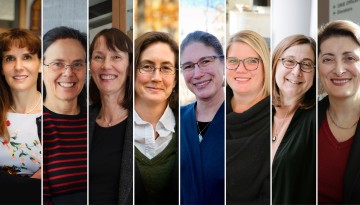
For the first time in Cornell Engineering’s history, every school and department currently has, or will soon have, a woman faculty member on the college’s executive leadership team. The milestone comes as the college celebrates the 140th anniversary of its first woman engineer.
On March 14 and 15, a series of free public events at Mann Library will celebrate Russian novelist and former Cornell professor Vladimir Nabokov's lesser-known but impactful contributions to the science of collecting, classifying and understanding the prismatic world of butterflies.
Awarded graduate students will study sustainability, biodiversity, accelerating energy transitions, advancing human health, increasing food security or addressing climate change.
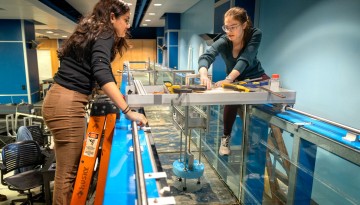
Two Cornell Engineering undergraduates are working to make arrays of wave energy converters – devices catch the waves and turn them into electricity – and move the technology closer to actuality.
Decades before any probe dips a toe – and thermometer – into the waters of distant ocean worlds, Cornell astrobiologists have devised a way to determine ocean temperatures based on the thickness of their ice shells, effectively conducting oceanography from space.
Carolyn Fornoff explores how contemporary Mexican writers, filmmakers and visual artists have reacted to climate change in her book "Subjunctive Aesthetics: Mexican Cultural Production in the Era of Climate Change."
The long-standing student dance group – committed to spreading the joys of Punjabi culture and dance – invites the Cornell and Ithaca community to its annual Bhangra showcase, the 21st PAO Bhangra, on March 16.
A Millard Meiss Publication Fund award will support the publication of Kelly Presutti's "Land into Landscape: Art, Environment, and the Making of Modern France.”