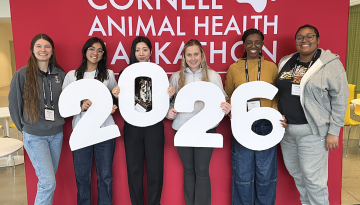
Products to fight ear infections in dogs, a parasite in cattle and animal population control challenges won top honors at the Feb. 20-22 Animal Health Hackathon at the College of Veterinary Medicine.
Cornell researchers have developed an online module, running just over an hour in length, that can be offered as a way to instill concepts of critical thinking early in a student’s academic journey.
Cornell researchers have uncovered a built-in molecular “gate” that controls the production of the molecule nitric oxide, a crucial signaling molecule throughout biology that in humans helps regulate blood pressure, brain signaling, and immune defenses. But when levels go unchecked, it can damage cells and disrupt normal signaling.
The study from an international team of experts in veterinary medicine, human medicine and genomics provides the first large-scale genetic map of feline cancer.
Bram Govaerts, director general of the International Maize and Wheat Improvement Center, will kick off the A.D. White Professors-at-Large spring 2026 visits with a pair of talks addressing agri-food research and innovation.
Five Cornell faculty members are among 126 early-career researchers across North America who have won 2026 Sloan Research Fellowships from the Alfred P. Sloan Foundation.
Immunotherapy has not worked well against fibrolamellar carcinoma, but a new study finds an existing FDA-approved drug may allow the treatment to fight the cancer as intended.
At high densities, white-tailed deer inhibit growth of trees but increase the overall diversity of smaller plant and weed species, according to a long-term study published Dec. 23 in PLOS One.