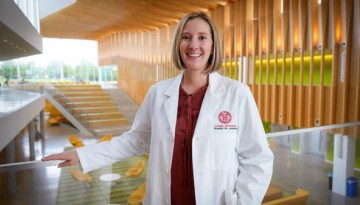
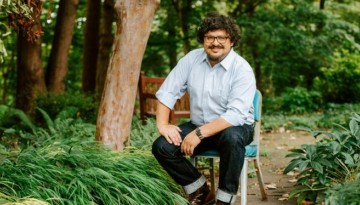
Dr. Erin Scott is an associate professor of ophthalmology in the Department of Clinical Sciences, and the second faculty member supported by the Cornell Margaret and Richard Riney Canine Health Center.
The Adam and Rachel Broder Fund for Cancer Research, which provides seed funding for scientists, is available to any Cornell faculty member. They are administered by the College of Veterinary Medicine, which has a long history of translational cancer research.
In an adaptation to climate change, tree swallows have become smaller over the last three decades, an ongoing study based in Tompkins County has found.
A new perspective piece from the College of Veterinary Medicine highlights the vital relationship between wildlife health and the North American Model of Wildlife Conservation.
Cornell scientists have created an evolutionary model that connects organisms living in today’s oxygen-rich atmosphere back billions of years – to a time when Earth’s atmosphere had little oxygen.
Halomine and Inso Biosciences – both from Cornell incubators – have received $3 million in New York state grants to help thwart disease outbreaks and expand the state’s life science industries.
Mario Herrero, a professor in the Department of Global Development and a Cornell Atkinson Scholar, has been appointed to the EAT-Lancet 2.0 leadership team to spearhead the modeling workstream.
Faculty and staff at Cornell’s Animal Health Diagnostic Center have helped prevent the spread of the devastating disease in New York, keeping the number of cases remarkably low.