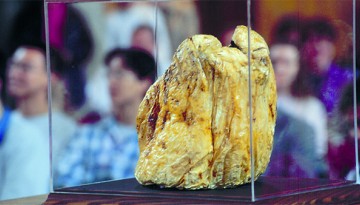
On the brisk autumn morning of Wednesday, Oct. 8, 1997, Cornell students, faculty and staff strolling by McGraw Tower noted an unusual sight: a large pumpkin impaled on the spire 173 feet up. The question remains: Whodunit?
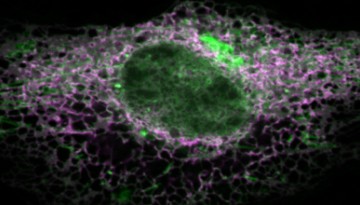
Researchers in the Department of Chemistry and Chemical Biology have improved an imaging method they developed in order to better track activity of a cell signaling enzyme that plays a role in cancer cell metastasis.
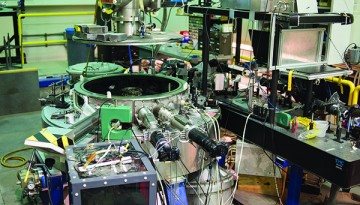
The Laboratory of Plasma Studies received a $15 million grant from the National Nuclear Security Administration and celebrates its 50th anniversary with a symposium Oct. 6-7.
The Department of Chemistry and Chemical Biology offers classes to teach students quantitative reasoning necessary for success in the physical sciences.
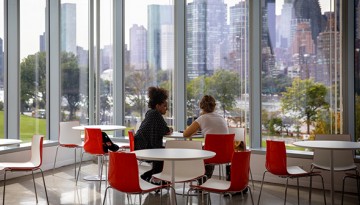
The new Roosevelt Island campus of Cornell Tech has catalyzed a slew of innovative academic programs that will benefit not only Cornell Tech students but also students from the Ithaca campus.
This week, researchers from Boyce Thompson Institute and Texas A&M University report new technology that may revolutionize the search for the perfect algal strain to produce biofuel.
“What Makes Us Human,” a new podcast and essay series from the College of Arts and Sciences, will showcase the newest thinking about what it means to be human in the 21st century.
Natasha Holmes is the first researcher who focuses on educational practices hired within a discipline as a tenure-track professor in the College of Arts and Sciences and her team will redesign all lab courses for two introductory physics sequences.