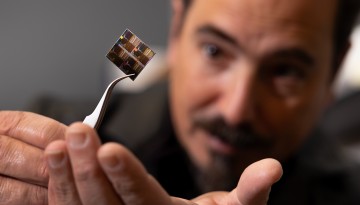
Cornell researchers in physics and engineering have created the smallest walking robot yet. Its mission: to be tiny enough to interact with waves of visible light and still move independently, so that it can maneuver, and take images and measurements.
The new injectable weight-loss drug reduced the risk of diabetes in patients with obesity and prediabetes by more than 90% over a three-year period, compared with placebo.
The secret to cellular youth may depend on keeping the nucleolus – a condensed structure inside the nucleus of a cell – small, according to Weill Cornell Medicine investigators.
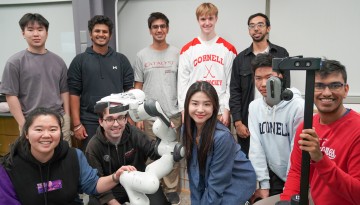
Professor receives three-year, $750,000 Young Investigator Program award from the Office of Naval Research to develop new ways to train robots to perform complex, multistep tasks, such as inspecting and repairing ship engines.
To meet a growing need, Enfield Food Distribution is working with a multidisciplinary Cornell team to design and raise funds for a larger, more welcoming facility.
The Sam and Nancy Fleming Research Fellowship program has been established and endowed by a gift from the Flemings to the Weill Institute for Cell and Molecular Biology. This Fellowship is awarded yearly and supports talented young researchers doing cutting-edge research in basic biomedical sciences and are planning careers in biological or medical research.
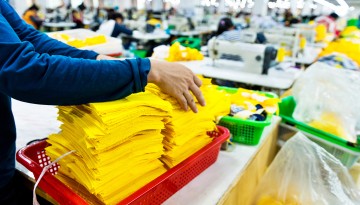
Companies in China that self-regulate to lessen harmful social practices – an increasingly prevalent strategy – are more likely to attract reputation-sensitive buyers and increase their exports to the Western world, new Cornell research finds.
The 2024 CROPPS Annual Meeting and Symposium held in October in the Sonoran Desert region of Arizona provided an ideal stage for discussions on sustainable agriculture in hot, dry environments.
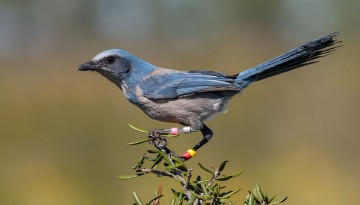
Warmer winters driven by climate change reduced the number of offspring raised annually by the federally threatened Florida scrub-jay by 25% since 1981, according to a study co-led by researchers from the Cornell Lab of Ornithology.