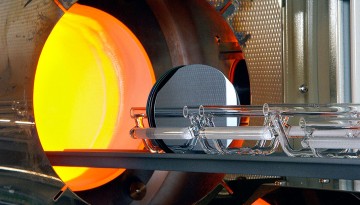
The National Science Foundation has renewed its funding for the Cornell NanoScale Science and Technology Facility with a five-year, $7.5 million grant.
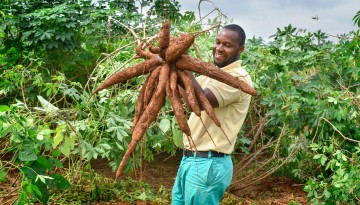
Scientists in Cornell’s NextGen Cassava project have uncovered new details regarding cassava’s genetic architecture that may help breeders more easily pinpoint traits for one of Africa’s key crops.
The rise of social media is actually undermining democratic regimes and giving authoritarian regimes the advantage, according to a new book from Sarah Kreps.
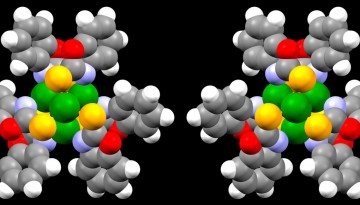
Cornell researchers discovered a way to bind and stack nanoscale clusters of copper molecules that can self-assemble and mimic complex biosystem structures at different length scales.
While many other animals are known to engage in group fidelity, where one male mates and socially bonds exclusively with two or more females, a new study documents this behavior for the first time in an amphibian.
In a new paper, Cornell researchers introduce a tool they’ve developed to improve the fairness of online rankings without sacrificing their usefulness or relevance.
Ray Jayawardhana, the Harold Tanner Dean of Arts and Sciences and professor of astronomy, has been awarded the 2020 Carl Sagan Medal by the Division for Planetary Sciences of the American Astronomical Society.
The World Economic Forum’s Strategic Intelligence website has tapped Nicholas Mulder, assistant professor of history, to share his expertise in geo-economics.
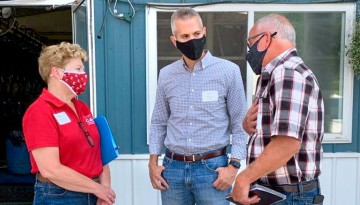
New York Congressman Anthony Brindisi met Aug. 10 with farmers and agricultural thought leaders – including Kathryn Boor ’80, the Ronald P. Lynch Dean of the College of Agriculture and Life Sciences – for a tour of E-Z Acres dairy farm in Homer.