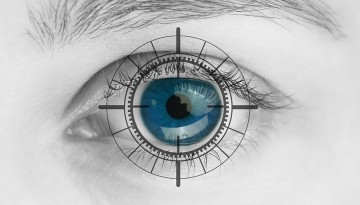
Cornell and Stanford University researchers have solved the three-dimensional structure of a protein complex involved in vertebrate vision at atomic resolution.
U.S. cities could see a decline in mortality rates and an improved economy through midcentury if the federal government maintain strong air pollution policies to diminish diesel freight truck exhaust.
Gallium nitride, a semiconductor that revolutionized energy-efficient LED lighting, could also transform electronics and wireless communication, thanks to a discovery made by Cornell researchers.
After an eight-month study, a task force of 16 faculty members has chosen “Migrations” as the theme of the first Cornell Global Grand Challenge, which will tackle the issue with resources from across the university.
As the Faculty of Computing and Information Science celebrates its 20th year, Frank Rosenblatt’s prescient research into artificial intelligence underscores Cornell’s pivotal role in computing history.
The “New Day at the MTA” conference, co-sponsored by the Metropolitan Transportation Authority, the Jacobs Technion-Cornell Institute at Cornell Tech and the Empire State Development Corporation, explored solutions for an aging transit system that moves 8.6 million people a day.
Silvia Ferrari, the John Brancaccio Professor of Mechanical and Aerospace Engineering, has been awarded a grant to study the brains of moths with the goal of improving drone flight.
Ian Greer, M.S. ’03, Ph.D. ’05, a senior research associate in the ILR School, built a class that explores unemployment and the effects surrounding it with the help of the Engaged Curriculum Grant program.