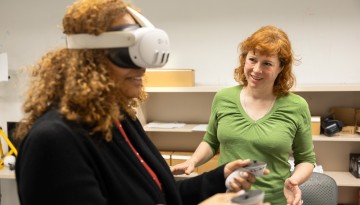
With brain mechanisms as a guide, Cornell researchers are designing low-energy robotic systems inspired by biology and useful for a wide range of potential applications.
The new Startup Cornell podcast episode features Van Hamilton Barbeau '11, MS/MBA '20, AVP at Ochsner Ventures, the venture capital arm of Ochsner Health.
Researchers in the Cornell SC Johnson College of Business found that consumers tend to overestimate fractional star ratings and underestimate fractional Arabic numerals. In either case, the ratings can be misleading.
Using machine learning technology, a new study has identified three distinct profiles describing social and economic factors that are associated with a higher risk of suicide.
The Roper Center for Public Opinion Research has announced its 2025 student fellows. This year’s cohort includes the W.E.B. Du Bois Fellow and three Kohut Fellows. These emerging scholars will advance data-driven research by contributing original scholarly work that uses Roper iPoll’s extensive survey archive.
For her work supporting the Ithaca community and people struggling with incarceration and drug addiction across New York, Netra Shetty ’25 earned the 2025 University Relations Campus Community Leadership Award.
Cornell researchers are working to understand how robots can assist humans in dangerous and physically challenging environments, but the project, which is funded by the U.S. Department of Defense, has been halted by a stop-work order.
Among those being recognized for exceptional teaching and mentorship this year are faculty members Begüm Adalet, Claudia Verhoeven, and Marcelo Aguiar.