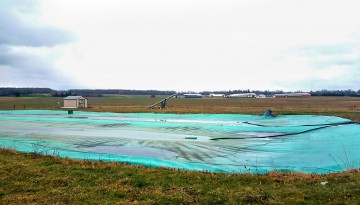
New York agriculture has the capacity to mitigate its own greenhouse gas emissions, two Cornell researchers say in a state-funded report commissioned by the New York State Department of Agriculture and Markets.
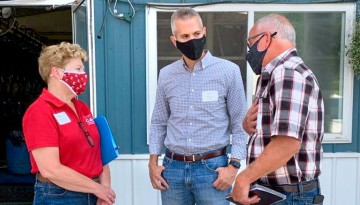
New York Congressman Anthony Brindisi met Aug. 10 with farmers and agricultural thought leaders – including Kathryn Boor ’80, the Ronald P. Lynch Dean of the College of Agriculture and Life Sciences – for a tour of E-Z Acres dairy farm in Homer.
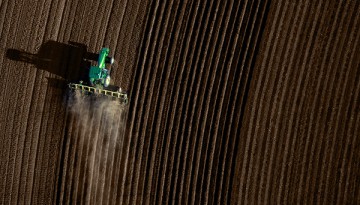
Cornell’s Art DeGaetano is one of nine scientists to co-author a USDA report to help the nation’s farmers and commercial agricultural managers reduce risk in the face of climate change.
Benjamin Houlton, director of the John Muir Institute of the Environment and professor of global environmental studies at the University of California, Davis, has been named the Ronald P. Lynch Dean, effective Oct. 1.
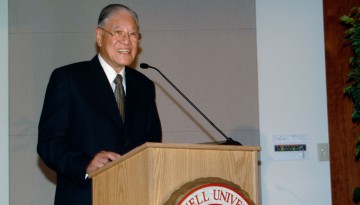
Lee Teng-hui, Ph.D. ’68, the first popularly elected president of Taiwan, who helped guide the island toward prosperity and democracy, died July 30 in Taipei. He was 97.
The National Science Foundation recently awarded Margaret Frank, assistant professor of plant biology, a $1.3 million Faculty Early Career Development Program grant for her study of mRNA communication in plants.
In Nature Geoscience, Cornell’s Johannes Lehmann says that scientists should develop new models that accurately reflect soil carbon-storage processes to draw down atmospheric carbon dioxide.