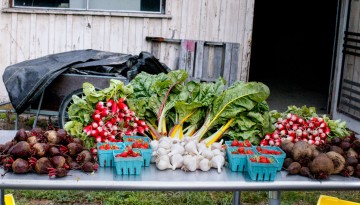
This year, with many people struggling due to COVID-19, Cornell faculty, staff and students facilitated the donation of more than 37 tons of food from farms run by Cornell AES to feed families in need.
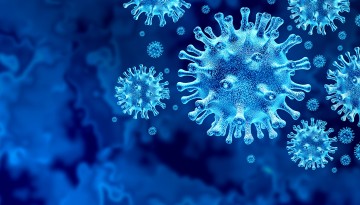
A Cornell-led project will use computer modeling and outreach to find optimal strategies to minimize COVID-19 cases and transmission among workers in food processing facilities, while maintaining the best possible production.
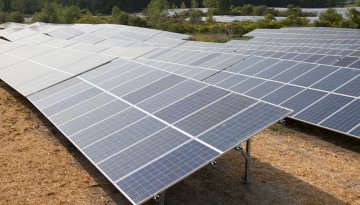
Engineering professor Max Zhang has been awarded a NYSERDA grant to determine efficient solar farm array configurations so the state can avoid land-use conflicts or spoiling precious agricultural space.
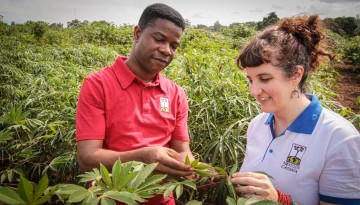
Ceres2030, headquartered at Cornell, aims to end world hunger by 2030. Harnessing machine learning and librarian savvy, the project identified the most effective ways to boost crops, empower farmers and protect the environment.
Small-scale farmers see a path to solving global hunger over the next decade, thanks to a Cornell-hosted project that used artificial intelligence to cull ideas from more than 500,000 scientific research articles.
A $676,000 grant from the U.S. Department of Agriculture’s National Institute of Food and Agriculture will help Cornell researchers, who are using high-resolution sensors to help vineyard growers identify nutrient deficiencies.
Seven postdoctoral researchers at Cornell were honored with a Postdoc Achievement Award as part of Cornell’s celebration of National Postdoc Appreciation Week, Sept. 21-25.
A $779,000 grant from the U.S. Department of Agriculture’s National Institute of Food Agriculture will help Cornell researchers prevent fire blight disease in apples and pears before it starts.
Environmental scientist Benjamin Z. Houlton, the new dean of the College of Agriculture and Life Sciences, says agriculture is the most important industry of the 21st century – and a powerful weapon to combat climate change.