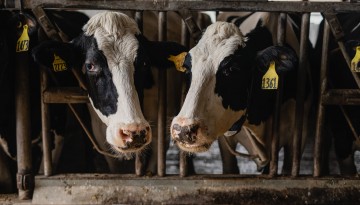
New York state students interested in dairy farming careers will get a boost thanks to a new scholarship program from the Chobani Foundation and the College of Agriculture and Life Sciences.
New York wineries and grape growers have become increasingly interested in sustainability as consumer express their growing interest in the provenance of their wines. This year’s B.E.V. NY conference focused on sustainability.
Fay Wei Li, from the Boyce Thompson Institute, and researchers from across the globe have sequenced the genomes of three hornworts, which could lead to crops that produce higher yields and use less synthetic fertilizer.
As plants try to strengthen their defenses against nematodes, those parasites try to outsmart them. New research shows that nematode species that move from plant to plant cause more than mechanical damage.
A Global Climate Change Science and Policy course supported by an Engaged Curriculum Grant is helping Cornell students and researchers lead efforts in Armenia to mobilize action related to agriculture.
Students in fields ranging from computer science and engineering to business, agriculture and animal science convened at the second Digital Agriculture Hackathon, Feb. 28-March 1, with a shared purpose: to combine their disparate skills to brainstorm ways to make the world a better place.
Researchers from Cornell and the Mars Global Food Safety Center can complete whole-genome sequencing to determine salmonella serotypes in two hours and the whole identification process within eight hours.
Trained Cornell Cooperative Extension agents teamed with New York State Department of Agriculture and Markets personnel across the state to offer free and confidential on-farm readiness reviews to insure that farmers can meet new produce safety standards.