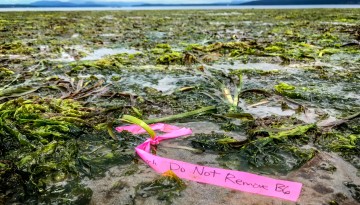
In an oceanic omen for climate change’s intensifying effects, Cornell-led research shows that seagrass suffers from a wasting disease and root-system deterioration.
C’Dots, silica-encased nanoparticles developed in the lab of engineering professor Ulrich Wiesner, have just begun their first therapeutic human clinical trial. They’re being further developed by Elucida Oncology Inc., a company co-founded by Wiesner.
Forty-four graduate students have been selected as new National Science Foundation Graduate Research Fellowship Program (NSF GRFP) fellows, joining Cornell’s community of nearly 200 NSF GRFP fellows currently on campus.
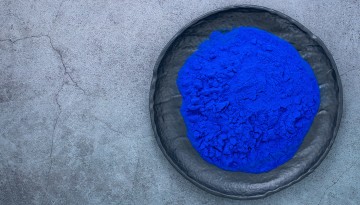
A natural food colorant called phycocyanin provides a fun, vivid blue in soft drinks, but it is unstable on grocery shelves. Cornell’s synchrotron is helping to steady it.
New Cornell research uses mathematical modeling to show that friendship networks can distort a voter’s sense of an election’s outcome, resulting in the victory of politicians who do not represent the preferences of the electorate as a whole.
Bhargav Sanketi earned third place in the Ivy+ Three Minute Thesis (3MT) competition. 3MT challenges graduate students to present their thesis research compellingly to general audiences in just three minutes.
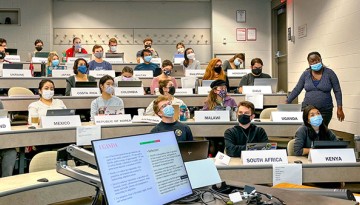
During the COP26 climate change conference, 45 Cornell undergraduate and graduate students plugged in from Ithaca to hear international negotiations first-hand and environmental history.
The Cornell Center for Social Sciences grant program, which supports social science research by Cornell faculty members and conferences that directly benefit Cornell faculty and students, has awarded $145,136 for 15 proposals for fall 2021.
The Graduate School welcomed over 80 new Dean’s Scholars into the community of over 300 current Dean’s Scholars at Cornell. The Dean’s Scholars program honors recipients of competitive diversity-focused fellowships.