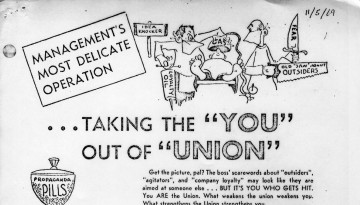
The Kheel Center for Labor-Management Documentation and Archives, in Catherwood Library, recently digitized the anti-union files donated by former HR executive Leonard C. Scott, who specialized in combatting labor unions.
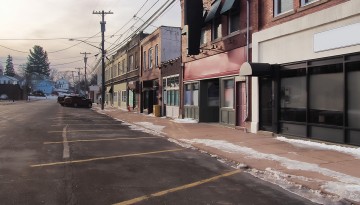
Cornell social scientists were part of a team that won the National Excellence in Multistate Research Award from the Association of Public and Land-Grant Universities and the United States Department of Agriculture.
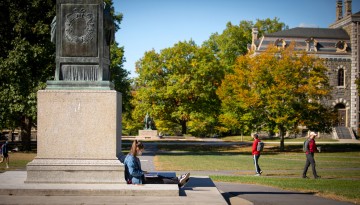
President Martha E. Pollack and Vice Provost for Undergraduate Education Lisa Nishii discuss getting out to vote, “semi-final” exams during the third and fourth weeks of November, and other topics.
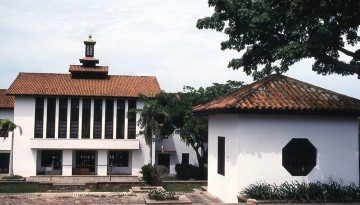
The Institute for African Development has been awarded a U.S. Department of Education grant to strengthen African studies and languages for Cornell undergraduates.
Caitlín Barrett, associate professor of classics in the College of Arts and Sciences, has been named a National Geographic Explorer after receiving a grant from the National Geographic Society to study daily life in ancient Rome.
The National Science Foundation has awarded the Cornell High Energy Synchrotron Source $32.6 million to build a High Magnetic Field beamline, which will allow researchers to conduct precision X-ray studies of materials in persistent magnetic fields.
Students and faculty in the College of Engineering are leveraging the university’s robust entrepreneurial ecosystem to launch a variety of tech startups.
Marketing strategies that boost feelings of psychological ownership can increase people's willingness to clean up trash, donate money and volunteer at public parks, according to research co-authored by Suzanne Shu, professor of marketing.