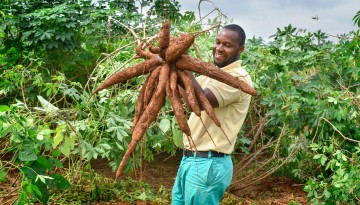
Scientists in Cornell’s NextGen Cassava project have uncovered new details regarding cassava’s genetic architecture that may help breeders more easily pinpoint traits for one of Africa’s key crops.
While many other animals are known to engage in group fidelity, where one male mates and socially bonds exclusively with two or more females, a new study documents this behavior for the first time in an amphibian.
Since requesting proposals in April, the Cornell Atkinson Center for Sustainability has awarded approximately $250,000 in rapid-response grants for COVID-19-related Cornell research.
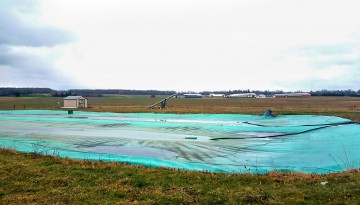
New York agriculture has the capacity to mitigate its own greenhouse gas emissions, two Cornell researchers say in a state-funded report commissioned by the New York State Department of Agriculture and Markets.
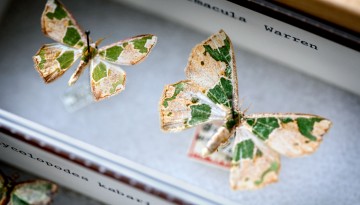
As director and head curator of the Cornell University Insect Collection, Corrie Moreau has numerous tasks on her to-do list, including one that could last her entire career: digitizing the collection’s 7 million specimens.
Leland “Skip” Carmichael, Ph.D. ’59, the John M. Olin Professor of Virology Emeritus and an expert on canine infectious diseases, died July 27 in Ithaca. He was 90.
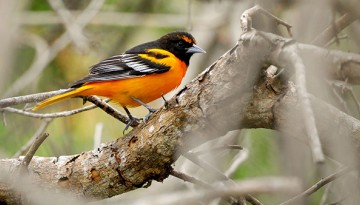
The debate is over: According to scientists from the Cornell Lab of Ornithology, Bullock’s and Baltimore orioles will remain separate species, despite hybridization where their ranges meet in the Great Plains.
Benjamin Houlton, director of the John Muir Institute of the Environment and professor of global environmental studies at the University of California, Davis, has been named the Ronald P. Lynch Dean, effective Oct. 1.
Herpetologist Harry Greene and evolutionary biologist Kelly Zamudio have an unexpected opportunity during the COVID-19 pandemic to “rewild” their newly purchased land in Texas, restoring its diverse, biological richness.