Urbano, a free software recently launched by Cornell researchers, employs data and metrics to help urban planners add walkability features to their designs.
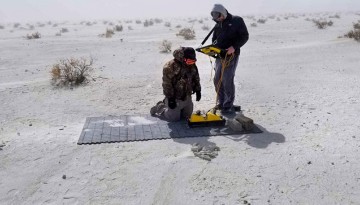
Invisible footprints hiding since the end of the last ice age – and what lies beneath them – have been discovered by Cornell researchers using a special type of radar in a novel way.
Three Cornell astronomers have been appointed to panel membership for the Decadal Survey on Astronomy and Astrophysics, a partnership between the National Academies and the astronomical community to identify key priorities in astronomy and astrophysics.
Cornell’s Center for Data Science for Enterprise and Society, launching this fall and led by David Shmoys, will enhance research in the increasingly important field of data science.
Cornell is co-leading a $9.95 million, five-year U.S. Department of Agriculture grant that aims to transform nutrition and water use in the poultry industry in order to improve its environmental impact and enhance human health.
Cornell researchers have found a way to build a zinc-anode battery that not only has a high energy density, but is low cost and stable, and has a life cycle that can be significantly prolonged.
Selecting the most effective molecules for drug delivery can be a trial-and-error process, but Cornell engineers have developed a new technique that provides some precision.
The Cornell Program in Infrastructure Policy will intensify its work on critical transportation and other infrastructure challenges with support from the Charles Koch Foundation.
The Cornell Center for Advanced Computing is among 10 collaborators awarded a $2.8 million grant from the National Science Foundation for a new astrophysics institute.