More than 200 people gathered April 24 to honor the civic outreach of Cornell students at the 2017 Community Engagement Showcase, which displayed several dozen projects associated with the community.
Professor Emeritus Robert Hughes, Ph.D. '52, who taught chemistry at Cornell from 1964 to 1980 and served as assistant director of the National Science Foundation, died in Virginia April 2. He was 92.
More than 200 Cornell undergraduate and graduate students joined 40,000 scientists and boosters to champion knowledge in the first March for Science in Washington, D.C., April 22.
Researchers show that coating the anode of a lithium-oxygen fuel cell with bromide results in more stable charging and could represent a step toward practical lithium-oxygen energy storage technology.
The Institute for the Social Sciences' Small Grants Program is funding a series of critical social science projects and a conference with its spring 2017 awards.
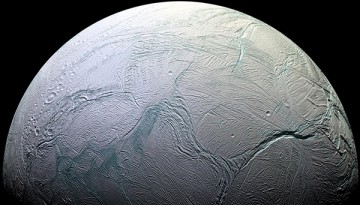
Scientists from the Southwest Research Institute, Johns Hopkins' Applied Physics Lab and Cornell confirm the presence of molecular hydrogen on a Saturn moon - a microbial food source and an ingredient needed for life.
Allen Jiang '18, a chemical engineering major from Redmond, Washington, has won a 2017 Goldwater Scholarship, which recognizes top undergraduates in mathematics, the natural sciences and engineering.
Applications of digital technology from academic disciplines across campus will be exhibited April 19 at the annual BOOM (Bits on Our Minds) exhibition.