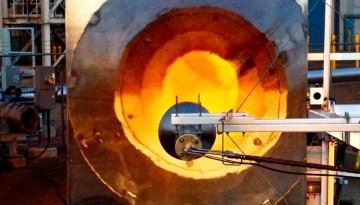
Assistant Professor Sadaf Sobhani is leading a $50,000 FuzeHub grant in partnership with ceramic 3D-printing company Lithoz America and energy startup Dimensional Energy to develop 3D-printed ceramics for clean energy reactors.
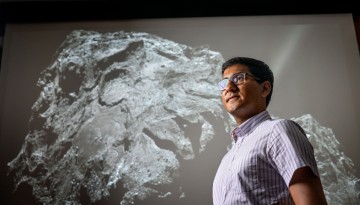
With an eye toward a return to Comet 67P, Cornell astronomers show how smooth terrain – a good place to land spacecraft and scoop samples – develops on the icy world of touring comets.
U.S. Senator Kirsten Gillibrand, a member of the Senate Agriculture Committee, visited Cornell Aug. 29 to champion agricultural conservation and climate-smart farming provisions in the Inflation Reduction Act and highlight related research and extension efforts in the College of Agriculture and Life Sciences.
An increase in consumer awareness around GMO-related topics – such as news coverage of legislative debate – is linked to an increase in demand for non-GMO products, even in states that didn’t ultimately pass GMO labeling laws, a new study finds.
NASA’s James Webb Space Telescope opens a new chapter in scientific history, as an international team – including Cornell astronomers – found carbon dioxide evidence on the exoplanet WASP-39b.
Krystyn J. Van Vliet, currently associate provost and associate vice president for research at the Massachusetts Institute of Technology, will join Cornell in 2023 as vice president for research and innovation.
Cornell Law School’s First Amendment Clinic was part of a team that won a precedent-setting ruling by a federal appeals court concerning the scope of amendments to the Freedom of Information Act.