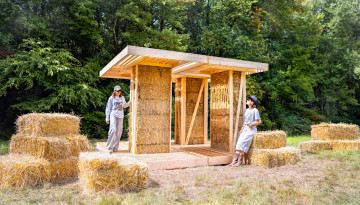
Straw, mycelium, hemp and dirt are building blocks in Marta Wisniewska's research and teaching focused on designing healthier spaces that mitigate the construction industry’s environmental impact.
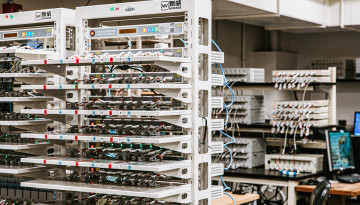
Cornell researchers, working with an upstate New York battery company, have developed a real-time diagnostic approach to improving one of the most expensive and time-consuming stages of lithium-ion battery manufacturing: forming the battery.
Most faculty, staff and students will have free access to a range of AI platforms – an effort to level the playing field, spur exploration and reduce the costs and vulnerabilities of individual consumer licenses.
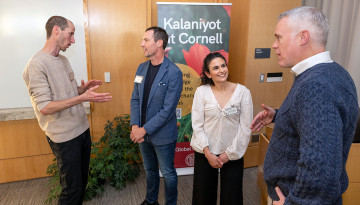
The Cornell chapter of Kalaniyot, a national faculty-led initiative focused on sustaining international academic collaboration by bringing scholars from Israel to Cornell, launched at a reception Oct. 19.
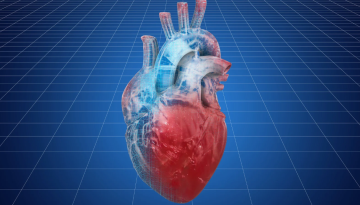
Reducing damage to the nuclei of heart muscle cells improved heart function and dramatically extended survival in mice with a form of inherited heart disease, according to a new study led by Cornell researchers.
Instructors across Cornell are working to strike a balance in the classroom – using AI as a teaching tool but also making choices to prevent its use and preserve the learning experience.
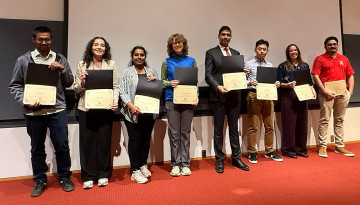
Postdoc Achievement Awards recognize postdocs who made outstanding contributions to the Cornell community, as well as faculty who provided exceptional mentorship to postdocs.
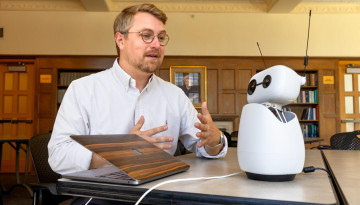
Gregory Falco, assistant professor, has received a Young Investigator Program award from the Air Force Office of Scientific Research to investigate autonomous spacecraft that can maintain coordination while an adversary is trying to disrupt them.
A National Science Foundation grant will support Cornell research aimed at developing AI models that can better represent human decision-making in cyber-physical systems while remaining interpretable and explicit about uncertainty.