Growing climate-smart crops is half the battle. Consumers need to understand sustainability claims and, more importantly, be willing to pay a premium for them.
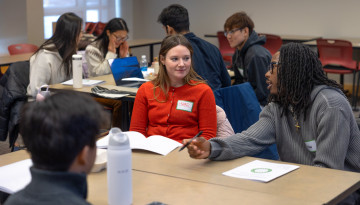
On a Saturday morning in February – the coldest day yet of a cold winter – more than 350 students trekked to Statler Hall for an innovative new course on civics.
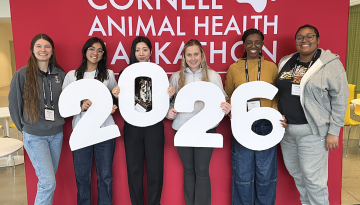
Products to fight ear infections in dogs, a parasite in cattle and animal population control challenges won top honors at the Feb. 20-22 Animal Health Hackathon at the College of Veterinary Medicine.
Cornell researchers have developed an online module, running just over an hour in length, that can be offered as a way to instill concepts of critical thinking early in a student’s academic journey.
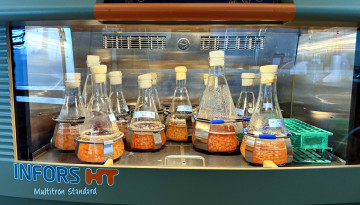
Researchers discovered electron transfer in electroactive bacteria is mediated by CymA proteins’ ability to synchronize and form a biomolecular condensate in the cell’s inner membrane.
New York Attorney General Letitia James has directed $1.1 million to support the new Cornell College of Agriculture and Life Sciences New York Soil Health Climate Smart Agriculture Fund, aimed at working with farmers to promote healthy soils.
A new artificial intelligence framework developed at Cornell can accurately predict the performance of battery electrolytes while revealing the chemical principles that govern them, providing engineers with a new tool for designing better batteries.