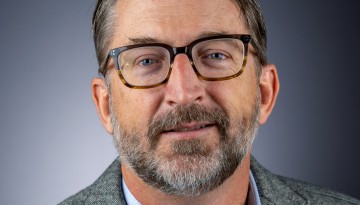
Steven Jackson, professor of information science in the Ann S. Bowers College of Computing and Information Science, with a dual appointment in the College of Arts and Sciences, has been named vice provost for academic innovation.
New Cornell research shows the metaverse – a virtual 3D environment in which the physical and digital worlds converge – could have environmental benefits: lowering the global surface temperature by up to 0.02 degrees Celsius before the end of the century.
Cornell is one of four higher-education institutions in a new $12 million partnership with Google aimed at establishing New York City as the world leader in cybersecurity.
As society ponders the dangers and unknowns of AI, Liz Karns is giving statistics students a first-hand look at the potential implications for users of large-scale predictive models, in hopes of increasing their empathy and awareness of unintended consequences.
A research team co-led by Cornell found that for schools without the resources to conduct learning analytics to help students succeed, modeling based on data from other institutions can work as well as local modeling, without sacrificing fairness.
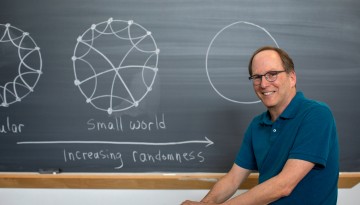
In 1998, Professor Steven Strogatz and then-student Duncan Watts, Ph.D. '97, published a model that launched the field of network science – the results of which are ubiquitous in today’s world.