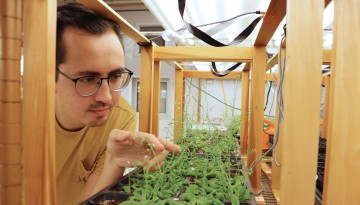
New tools and methods that enable the visualization and quantification of phosphate content in plants at the single-cell level could help agricultural researchers understand how crop plants use this important nutrient.
More than 180 young people from across New York state and the Philadelphia area got a taste of campus life and future career paths during the annual 4-H Career Explorations Conference, June 28-30.
Dan Aneshansley, Ph.D. ’72, professor emeritus of biological and environmental engineering, whose research impacted the state’s dairy and fruit production, died July 3. He was 79.
Specialty crop entomologists from Cornell AgriTech and the New York State Integrated Pest Management Program will use a three-year, $450,000 grant from the New York State Department of Agriculture and Markets to evaluate alternatives for controlling insect pests that threaten the state’s $1.4 billion specialty crop industry.
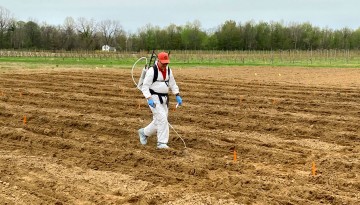
For the students on the Cornell Weed Team, who face endless marijuana wisecracks from nonscientists, competing in the Northeastern Weed Science Society’s tournament in Guelph is no joke.
The first comprehensive annotation of long intergenic non-coding RNAs (lincRNAs) in the genomes of four mustard species provides a solid foundation for understanding how these molecules contribute to important traits in agricultural crops,.
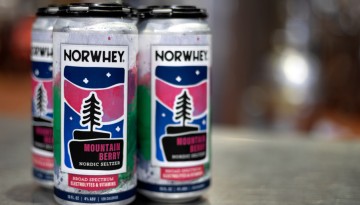
The brand is a triple threat: it’s an alcoholic beverage with a better nutritional profile, it’s made from material that would otherwise go to waste – and it could eventually act as a model for dairy farmers looking for additional revenue.
Mary Jo Dudley, director of the Cornell Farmworker Program (CFP) and senior extension associate in Global Development in the College of Agriculture and Life Sciences, has been named to the National Advisory Council on Migrant Health.