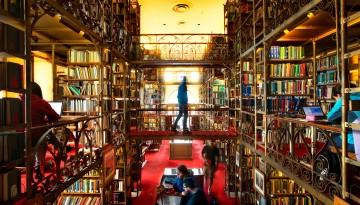
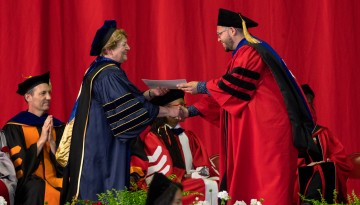
The Graduate School offers Summer Foreign Language Grants to help humanities students engage in summer learning opportunities. Thirteen doctoral students were awarded grants for study during summer 2023.
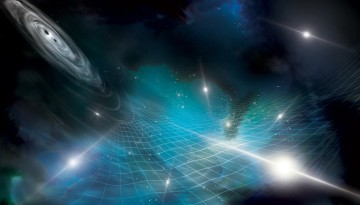
A collaboration including Cornell astrophysicists has found the first evidence of low-frequency gravitational waves believed to be generated by merging pairs of supermassive black holes.
The “widowhood effect” – the tendency for married people to die in close succession – is accelerated when spouses don’t know each other’s friends well, new Cornell sociology research finds.
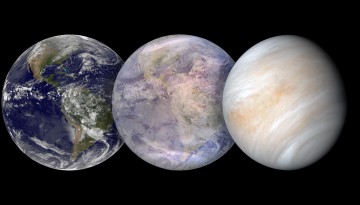
A recently discovered exoplanet may provide insights about conditions at the inner edge of a star’s habitable zone, and why Earth and Venus developed so differently, according to new astronomy research led by Lisa Kaltenegger.
Jumana Badar, a fifth-year doctoral candidate in the graduate field of biochemistry, molecular and cell biology, has been selected for the 2023 Harry and Samuel Mann Outstanding Graduate Student Award.
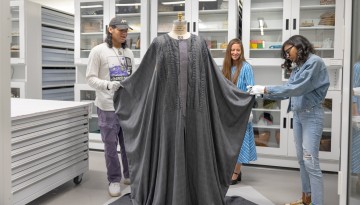
The majestic robe owned by the iconic fashion editor André Leon Talley is the latest of several acquisitions that further diversify the Cornell Fashion + Textile Collection.
New Cornell research shows the metaverse – a virtual 3D environment in which the physical and digital worlds converge – could have environmental benefits: lowering the global surface temperature by up to 0.02 degrees Celsius before the end of the century.
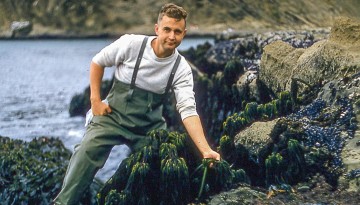
John Kingsbury, professor emeritus of botany, who developed a small island in the Gulf of Maine into an living classroom for students eager to learn about the sea, died May 27 in Vermont.