New tools and methods that enable the visualization and quantification of phosphate content in plants at the single-cell level could help agricultural researchers understand how crop plants use this important nutrient.
More than 180 young people from across New York state and the Philadelphia area got a taste of campus life and future career paths during the annual 4-H Career Explorations Conference, June 28-30.
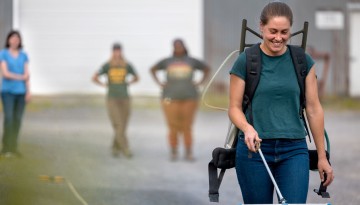
For the students on the Cornell Weed Team, who face endless marijuana wisecracks from nonscientists, competing in the Northeastern Weed Science Society’s tournament in Guelph is no joke.
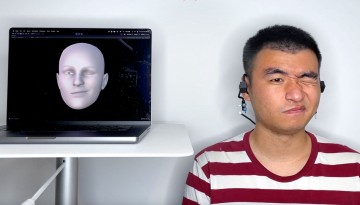
Cornell researchers have developed a wearable earphone device – or “earable” – that bounces sound off the cheeks and transforms the echoes into an avatar of a person’s entire moving face.
A new study demonstrates for the first time that the same undersea fiber-optic cables used for internet and cable television can be repurposed to tune in to marine life at unprecedented scales, potentially transforming critical conservation efforts.
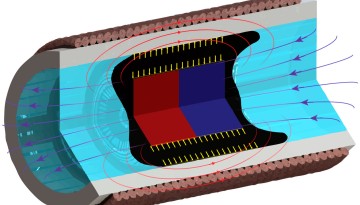
A collaboration between Cornell researchers and the U.S. Army Research Laboratory has leveraged hydrodynamic and magnetic forces to drive a rubbery, deformable pump that can provide soft robots with a circulatory system, in effect mimicking the biology of animals.
The platform, called Pathways, was designed to assist and inspire current students as they explore and make informed decisions such as choosing courses and majors.
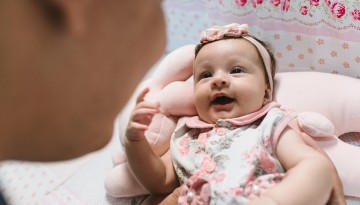
In a new study, Cornell psychology researchers have found that babies learn their prelinguistic vocalizations – coos, grunts and vowel sounds – change the behaviors of other people, a key building block of communication.