New Cornell research published online Nov. 9 in Nature Cell Biology describes a system that controls levels of a cell's sensors, which are responsible for detecting the accumulation of misfolded proteins.
Cornell biomedical engineers have developed specialized white blood cells – dubbed "super natural killer cells" – that seek out cancer cells in lymph nodes with only one purpose: destroy them.
Researchers at the Boyce Thompson Institute are studying the bacterium speck, which causes withered flowers and dark spots on leaves and fruits, and can result in the loss of whole fields of crops.
A $7.5 million gift from the Macaulay Family Foundation to the the Cornell Lab of Ornithology will expand the Macaulay Library's scientific archive of natural sound and video recordings.
College of Veterinary Medicine professor Dr. Robin Radcliffe is raising local awareness of two vanishing rhino species in Indonesia via a book for Indonesian children, “The Hornless Rhinoceros."
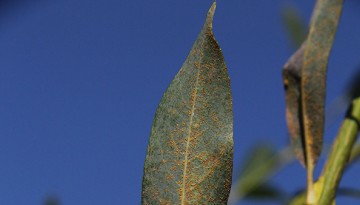
A $1 million grant from the U.S. Department of Agriculture and the U.S. Department of Energy will help Cornell researchers elucidate the genetic underpinnings of resistance in shrub willow.
Biochemist Jennifer Doudna, who developed a new technique in genome engineering that allows DNA to be edited almost as easily as editing text, will deliver the Racker Lecture on campus Nov. 19.
Boyce Thompson Institute are working to apply a method that boosts beta-carotene into in potatoes to cassava plants. Biofortified cassava could help alleviate vitamin A deficiency in children.
In the war against MRSA, constructing single-patient rooms – rather than sick-bay style, multi-patient rooms – reduces hospital-acquired infections among patients, says new Cornell-led study.