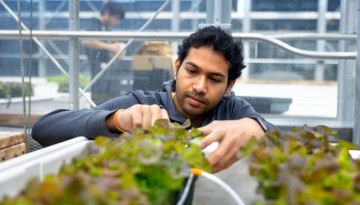
Led by College of Architecture, Art and Planning experts, “Embodying Justice in the Built Environment: Circularity in Practice” seeks to help communities center justice principles while implementing sustainability strategies.
Empire AI, a $400 million effort to create a shared academic research computing facility, is set to advance dozens of ambitious, cross-disciplinary projects at Cornell.
Plenty of studies link exposure to the natural world and improved mental and physical health, but a new Cornell study connects enjoyment of nature to a specific biological process – inflammation.
We live in an era in which rapid technological change shifts the global security balance in real time. No one knows that better than Sarah Kreps, director of the Brooks School Tech Policy Institute (BTPI), and John L. Wetherill Professor in the Department of Government in the College of Arts & Sciences.
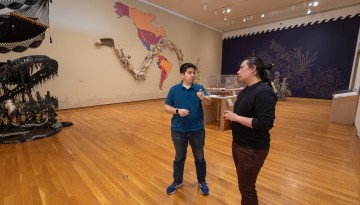
At Cornell’s Johnson Museum of Art, the work of renowned artist Guadalupe Maravilla is on display in the same space as that of Ingrid Hernandez-Franco, a Salvadoran woman whose asylum case was championed by a Cornell professor and her students.
Cornell faculty members Ailong Ke, David Shmoys and Martin T. Wells have been elected fellows of the American Association for the Advancement of Science, the world’s largest general scientific society.
Cornell food scientists are working with wineries, manufacturers and New York state to eliminate the “off” aroma in some canned wines by subtly altering the product’s formulation and packaging.
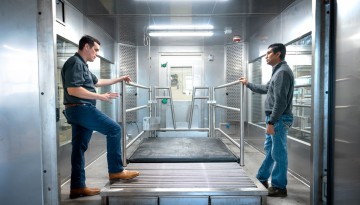
New climate-controlled animal respiration stalls in CALS – the only ones currently operating in the U.S. – will allow researchers to measure, verify and monitor methane and other gas emissions from cows.
Purple bacteria is one of the primary contenders for life that could dominate a variety of Earth-like planets orbiting different stars, and would produce a distinctive "light fingerprint," Cornell scientists report.