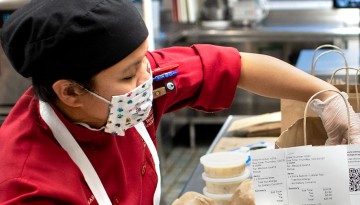
A Cornell-led research group found an improvement in the perceived service quality of restaurants where the minimum wage rose from $8 to $10 an hour, including reduced negative discussion of the courtesy and friendliness of workers.
Internal job applicants who face rejection are nearly twice as likely to leave their organizations than those who were either hired for an internal job or had not applied for a new job at all, ILR School research finds.
ILR School experts continue to help the public, policymakers, labor, management and others understand how the pandemic is impacting the future of work. This Labor Day, we’re highlighting some of the topics ILR experts addressed and their insights on how the world of work will look on Labor Day 2022.
Children with infantile spasms, a rare form of epileptic seizures, should be treated with one of three recommended therapies and the use of nonstandard therapies should be strongly discouraged, according to new research from Weill Cornell Medicine.
Even with federal provisions aimed at protecting workers, instances of sick people being unable to take time off tripled during the pandemic, new Cornell research has found.
Black employees who engage in racial codeswitching are consistently perceived as more professional, by both Black and white individuals, than employees who do not codeswitch, according to new ILR research.
Concrete expert Ken Hover, Ph.D. ’84, professor of civil and environmental engineering, will help the federal government investigate the June 2021 collapse of the Champlain Towers South condominium in Surfside, Florida.
New research on the glittering White-necked Jacobin hummingbird reveals nearly 20% of the species’ adult females have male-like plumage. Why? To dodge bullies and get better access to food, according to new Cornell research.
Cornell assistant professors researching artificial intelligence, sustainable energy, digitization in manufacturing and chemistry have recently received early-career awards from the National Science Foundation and the Department of Energy.