Cornell is a global leader in sustainability and climate change research, teaching and engagement. Our campuses are living laboratories for developing, testing and implementing solutions that address these most challenging issues.
Rawlings credits students for driving climate action

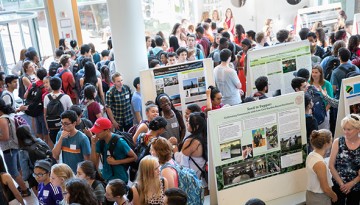
Interim President Hunter Rawlings gave students credit for propelling the university into action at the President’s Sustainable Campus Committee annual summit Nov. 10.

Soil scientist speaks on land degradation at COP22

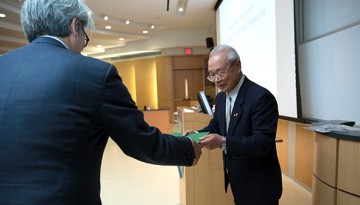
In a presentation to global leaders battling climate change and feeding a burgeoning world population, Cornell's Dawit Solomon presented food security ideas to stave off the Earth's atmospheric warming.

Grant to aid study of microbes' role in soil carbon cycle

A project led by Cornell researchers to better understand soil microbes and their role in the carbon cycle has received a three-year, $3.59 million grant from the U.S. Department of Energy.

Functional textiles clean pollutants from air and water

A group of Cornell researchers has shown the ability to functionalize cotton fabric with a porous beta-cyclodextrin polymer, which can sequester organic micropollutants in both water and air.

Cornell eases water use restrictions but urges conservation

Cornell has lowered its water use restriction to a water use advisory, which means water conservation efforts are now strongly encouraged but not required.

Public health symposium to take place Nov. 4

The 2016 Cornell University One Health + Public Health + Global Health Symposium will take place Nov. 4, 8 a.m. to 4 p.m., in Biotech G10 and the lobby.

Panel outlines action for campus carbon neutrality by 2035

With a plan to harness the wind, sun, water and the Earth’s heat, a panel from the Senior Leaders Climate Action Group explained to the Cornell community Oct. 31 how the campus could become carbon neutral by 2035.

Study: A species' risk of extinction is in the eye of the beholder

The way conservation biologists describe a species' risk of extinction, and how the public interprets that description, can be strikingly different, according to a new study by Cornell communication scholars.

Colorado River's dead clams tell tales of carbon emission

Scientists have begun to account for the topsy-turvy carbon cycle of the Colorado River delta – once a massive green estuary of grassland, marshes and cottonwood, now desiccated dead land.