Cornell will host a Precision Nutrition Symposium, Oct. 14-15, designed to foster the development of collaborative and multidisciplinary working groups from Cornell’s Ithaca and New York City campuses.
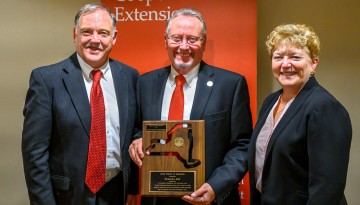
Richard Ball, New York State Department of Agriculture and Markets commissioner, was presented the Friend of Extension Award by Cornell Cooperative Extension at a ceremony Sept. 26 at Cornell’s Statler Hotel.
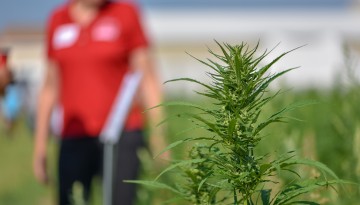
Larry Smart, professor in the Horticulture Section of the School of Integrative Plant Science, recently joined Cornell Cooperative Extension’s “Extension Out Loud” podcast series to discuss industrial hemp production in New York state.
James Clarence Preston ’50, Ed.D. ’68, a former Cornell Cooperative Extension agent and a professor of rural sociology from 1968 to 1988, died Sept. 2. He was 92.
A Nobel Prize-winning physicist, best-selling authors and a leader in global sustainable agriculture are among six newly elected Andrew Dickson White Professors-at-Large at Cornell.
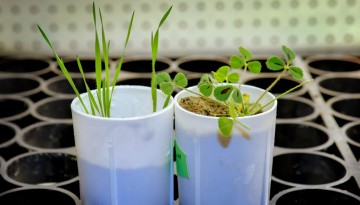
A discovery by Boyce Thompson Institute scientists could help farmers improve phosphate capture, potentially reducing the environmental harm associated with fertilization.
To safeguard the world’s wheat crops, disease-resistance genes must be deployed in an informed way, according to Maricelis Acevedo, adjunct professor in the College of Agriculture and Life Sciences.
Three collaborative New York City-based projects, designed to inspire cross-campus research partnerships, have been awarded grant funding totaling approximately $500,000 from the College of Agriculture and Life Sciences.