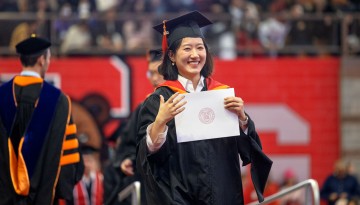
On Dec. 18 in Barton Hall, more than 700 recipients of bachelor’s, master’s and doctoral degrees were honored at the university’s 20th recognition ceremony for December graduates, held in-person for the first time since 2019.
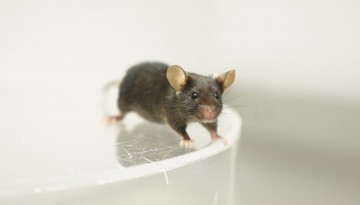
Cornell researchers found a link between the rate of ultrasonic vocalizations in mouse pups and their activity levels, which is important for understanding mouse models of communication disorders, including autism spectrum disorder.
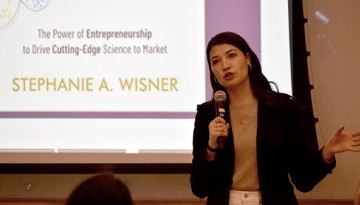
On Nov. 18, Stephanie Wisner '16 discussed her career path and new book, "Building Backwards to Biotech: The Power of Entrepreneurship to Drive Cutting Edge Science to Market," with Cornell's entrepreneurial community.
A Cornell research team identified barriers to immigrants’ use of online resources that could help them access health and legal benefits, and recommended solutions they incorporated into a new website, Rights for Health.
Due to faster decomposition, disposable and plasticized biodegradable medical gowns introduce greenhouse gas discharge problems in landfills, according to new Cornell engineering research.
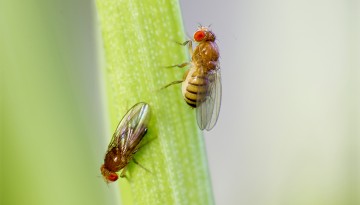
Researchers pinpointed the neuromuscular components that enable a fruit fly to stabilize its pitch, providing evidence for an organizational principle in which each muscle has a specific function in flight control.
An apple a day may keep the veterinarian away. Juice, pulp and other waste from Empire apples, when injected into chicken eggs before hatching, show signs of boosting the animal’s health.
Cornell doctoral candidate Bethany Jorgensen co-authored the 2022 Lanzarote Declaration – a synthesized wish list of action in anticipation of a U.N. treaty on global plastic pollution in 2024.
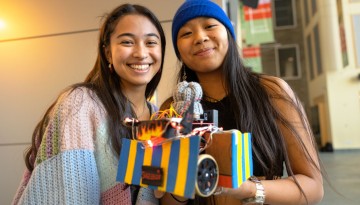
Simplicity was a winning strategy for a trio of engineering students in the annual Cornell Robotics Competition, held Dec. 1 in the Duffield Hall atrium.