A Cornell-led collaboration set out to study thermal conduction in the superfluid helium-3 and discovered a series of unexpected phenomena that reaffirm just how dynamic and unconventional the material is.
The Cornell Alliance for Science is expanding its mission of science communication and advocacy and broadening its commitment to diversity and inclusion thanks to $10 million in new funding from the Bill & Melinda Gates Foundation.
The history of superconducting materials has been a tale of two types: s-wave and d-wave. Now, Cornell researchers have discovered a possible third type: g-wave.
The NSF has awarded a $1.5 million grant for Cornell researchers to study the health dangers, changes in the lake food web and socioeconomic challenges when these algal blooms produce toxins.
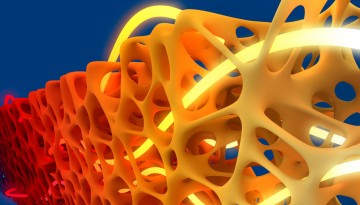
A Cornell researcher is developing a technique for precise fabrication of porous ceramic materials, opening a new realm of possibilities for their application in industrial and biomedical products.
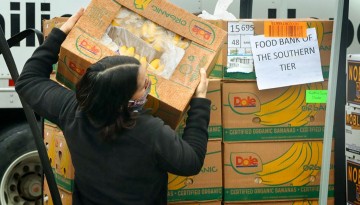
Cornell systems engineers examined data from a busy New York state food bank and, using a new algorithm, found ways to better allocate food and elevate nutrition in the process.
A rocky planet orbiting a white dwarf – a star in a phase after death – would present an excellent opportunity to search for molecules that signify life using the James Webb Space Telescope, Cornell researchers write in the Astrophysical Journal Letters.
The powerful new telescope being built for a high-elevation site in Chile by a consortium of U.S., German and Canadian academic institutions, led by Cornell, has a new name: the Fred Young Submillimeter Telescope.