Veterinarian Alfonso Torres is co-leading the charge to increase the number of veterinarians around the world who are familiar with animal diseases that could threaten the health of livestock and poultry globally.
Ph.D. student Leliah Krounb is studying how to turn human waste into soil nutrients in Kenya by using pyrolysis – thermal combustion in the absence of oxygen.
Emeritus professor Robert D. Sweet died Jan. 39 at age 98. He was the former chair of the Department of Vegetable Crops, a precursor to the Department of Horticulture, and an expert on weed control.
National 4-H Council president and CEO Jennifer Sirangelo was hosted by Cornell University Cooperative Extension-New York City Jan. 27 in a tour of the Food and Finance High School's Hydroponics, Aquaculture, Aquaponics Learning Labs.
A three-year study by Cornell researchers suggests that growth in local farm aggregation and distribution businesses may provide economic benefits to local communities, but that some other businesses may suffer.
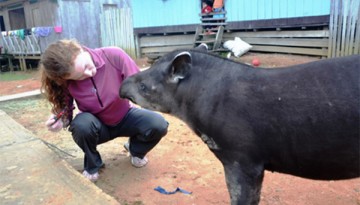
Cornell veterinary student Emily Aston ’15 went into the heart of the Amazon to conduct the most remote study to date of the foodborne and waterborne pathogen Toxoplasma gondii.
To feed the world’s burgeoning population while saving it from exhausting natural land resources, the United Nations issued a report on global land use.
Andrew Landers, a senior extension associate at Cornell’s New York State Agricultural Experiment Station in Geneva, has developed sprayers that reduce excess pesticide use.