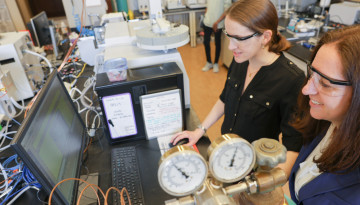
From drones that monitor crop health to plants that send text messages, middle and high school students at Cornell’s Expanding Your Horizons conference experienced firsthand how plant science and technology are shaping the future of agriculture on April 5 in Barton Hall.
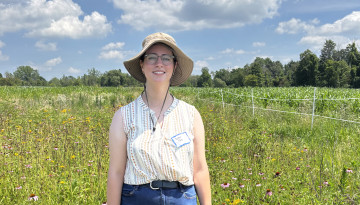
Cornell AES manages farms and greenhouses that support research but are also unique teaching resources for over 40 courses. This is the sixth story in a series about on-farm teaching; in Cover Crops in Agroecosystems, students explore the uses of cover crops and assess their benefits.
In collaboration with farmers, researchers found that emission intensities from New York state dairy farms were lower per gallon of milk than national estimates and among the lowest reported across continents.
A new publicly available tool uses data from the Cornell Lab of Ornithology’s eBird program to track and estimate the diversity of wild bees across the eastern and central U.S. - with implications for conservation and agriculture.
Researchers have created a computer model that can help produce farms and food processing facilities control COVID-19 outbreaks, keeping workers safe and the food chain secure.
In the U.S., strategically converting a small fraction of land used to grow corn for ethanol to solar facilities could vastly increase energy production per hectare, as well as provide ecological benefits and financial resiliency for farmers.
A new study, published in Global Change Biology, presents five case studies that demonstrate how deep collaboration can transform crop monitoring, fertilizer use and water management to tackle the most significant challenges facing farming: water status, fertilizer systems and phosphorus recovery.